Sunday, May 31, 2026

A Malagasy Language Lesson

I put a few Malagasy lessons up on Youtube. I will share the script of one of them, the third of the series that was narrated by Heri Manjato. To listen to the Malagasy, click here.

I wanted to share the script of Heri's video for those interested in learning and/or listening to this beautiful language. As with many of my videos, I like to include proverbs and cultural references, so of course I started this lesson with one of my favorite proverbs narrated with the University of Antananarivo as the backdrop by Larissa Randriasoa and Manuellà Randrianandrasana. 


And now the script in Malagasy and English:


Let’s learn some Malagasy!

Andao ianatra teny Malagasy kely e!

My name is Rafi and I’ll be your teacher today.

Rafi no anarako ary izaho no ho mpampianatra anareo androany.

Hello / Thanks

Veloma / Misaotra

Malagasy is a beautiful language.

Fiteny mafinaritra ny teny Malagasy.

Listen carefully and repeat:

Henoy tsara dia avereno avy eo.

What are you doing?

Inona ny ataonao?

Where are you going?

Ho aiza ianao?

Who are your parents?

Iza ny ray aman-dreninao?

Why are you dancing?

Fa maninona no mandihy ianao?

How long will you stay in Madagascar?

Hafiriana ny ijanonanao any Madagasikara?

I’m very sad because I’m going home tomorrow.

Malahelo kely aho fa andeha hody rahampitso.

I want to see the lemurs in the forest.

Te ahita ireo varika any anaty ala aho.

When do you plan to visit my country?

Rahoviana ianao no mieritreritra ny hitsidika ny fireneko?

This is my beautiful dog, Maggie.

Izy no alikako manja kely Maggie.

My dog is only four months old.

Vao efa-bolana ny alikako.

Margaret likes to play with her friend Daisy.

Tia milalao miaraka amin’ny namany Daisy i Margaret.

I love to travel with my friends.

Tiako ny mandeha mitsangatsangana miaraka amin’ny namako.

How do you cook chicken?

Ahoana ny fomba fandrahoanao akoho?

When will you visit me?

Rahoviana no hitsidika ahy ianao ?

Did you finish your homework?

Nahavita ny enti-modinao ve ianao?

How many children do you have?

Firy ny zanakao?

What do you want Chef Rafi to cook today?

Inona no tianao andrahoana androany ry Sefo Rafi?

Always cover your mouth to avoid the virus!

Manaova aro-tava foana mba tsy ho tratry ny virisy.

It was nice meeting you.

Nahafinaritra ny nifakahita taminao.

I hope we can see each other again soon.

Manatena aho fa mbola hiaona indray isika.

Where should we go next?

Aiza no tokony andehanantsika manaraka?

I like to cook and travel the world.

Tiako ny mahandro sy ny mitety izao tontolo izao.

One day I dream of going to Madagascar.

Indray andro any, manonofy ny andeha ho any Madagasikara aho.

Subscribe to my channel and I’ll teach you how to cook.

Manaova famadrihana ao amin’ny sehoko dia ampianarako mahandro ianao.

Come see us again soon here at ChefRafi.com

Tongava mitsidika anay ao amin’ny ChefRafi.com

If you want to check out my other Malagasy videos, you can look how to cook Malagasy food in coconut milk, click here. I also have a Malagasy lesson video filmed in Paris where we learn about Malagasy beef stew, romazava.

There will be lots of cameo lemur appearances, as well as a cameo by Professor Marianna Mithun!

Saturday, April 22, 2017

ATAYAL: Introducing an Indigenous Language of Taiwan via food

Well, it has been years since my last blog but my cooking show is still going strong. We were featured in a number of papers and TV including the AsturianParaguayan and Guamanian press for our work with indigenous languages and cuisine. So when I have time I'll share you those recipes and experiences.

But for now, I would like to share with you a real treasure of humanity - an interlinear gloss of my Taiwanese Steamed Fish video, showing the beauty and complexities of one of Taiwan's endangered indigenous languages: Atayal.
Atayal is spoken in Northern Taiwan, the map above shows the two major dialects, Squliq and C’uli’.

Although the Atayal language is only spoken in the island of Taiwan, it is NOT related to Chinese in any way. It is an Austronesian language most closely related to the languages of the northern Philippines, like my language! The Ethnologue reports that is is spoken by 84,300 people. These are the ingredients needed to make this dish (in both languages). The ingredients proportions will vary depending on the size of the fish. This is for one pompano fish (but many saltwater white flesh fishes will do). Use white fleshed fish which have a more delicate flavor.

Ingredients Needed

ENGLISH
ATAYAL
1 whole white fish
qutux s’rux qulih
Ginger
quriq
Green onions (scallions)
qinuw
Soy Sauce
toyu’
Rice wine vinegar
mngihuy na’ qwow
Coriander leaves
abaw ramat ka blaq sokan
Chili peppers (optional)
qurip muyaw
Cooking oil
suyu’

The dish is simple, yet delicious. It's extremely easy to make. I'll show you how in this bilingual video dedicated to the Atayal and the original inhabitants of Taiwan.


The video closes with an Atayal proverb:
Maha qutux squliq ga, ini’ qbaq kinraral qani ga, iyat nya’ baqun maha pkusan nanu’ mqyanux la.
"If one doesn’t know history he will not know how to live."

Before I share with your the interlinear gloss of my Atayal video's narration, I would like to give a very special thanks to Maya Yu-Ting Yeh and Hama’ Ihil (Yue-mei Xu) for their wonderful and patient help with their language as well as beautiful Atayal narration. I have new recipes each week, so subscribe now so you don't miss any of my shows!

Before sharing the interlinear gloss for interested linguists, here's the Atayal video narration first in the official orthography. Listen to it with the English subtitles here:

Blaq simu’ kwara’? kun ga, ptayak Rafi. Mqas saku’ balay mwah simu’ sa kamuk mu qani.
Kira’ ga, pcbaqun simu’ maha, son nanu’ pskulu’ qu’ qutux s’rux na’ qulih.
Qani ga, ’llaw balay qu’ thqun na’ ramat.
Kun ka ptayak qani ga, blaq mu pcwakun qu’ qulih na’ umi’. Slaqux nya’ qu’ qulih na’ pitung hya’.
Baqun su cyux maki’ inu’ qu’ ttayal hya’? Si ktai qu’ pintasan ka biru’ qani.
Kwara’ qani ga, nanu yasa qu’ nyux su ggalan sa pcwakan qani.
Nyux su ggalun qani ga, qutux s’rux plquy na’ qulih. Laxi prungi qu’ tunux na’ qulih.
Pinbaq mita’ qu’ qulih qani! Qinu’ na’ giqas balay. Ini’ ksknux.
Pkslyut qmwax qu’ qulih qani. Agal kwara’ qu’ gyus na’ qsahuy nya’.
Te sazing binah nya’ ga, hboci cikay.
Yan qani hmubing qu’ qinuw ru qurip.
Si’ sa ktu’ ru babaw na’ qulih qu’ qinuw ru qurip qani.
Qurip qa ga, spposa’ sa yaqih kinsokan na’ qulih.
Spemaw qu’ toyu’ ru mngihuy na’ qwow lga, nanu stukun sa babaw na’ qulih.
Maha smoya’ su sa melux ga, nanu twangi qurip muyaw uzi’
Shmiq qu’ qsya’, pskulu sa qulih ru, spat puzit lga, yasa la.
Galun qu’ qulih. Syun sa ska’ na’ sara’.
Skluxun qu’ suyu’ ru, stukun sa babaw na’ qulih. tmwang sa kinsokan.
Abaw ramat ka blaq sokan ga, syun sa babaw qulih. Skbetunux ktan.
Maha qutux squliq ga, ini’ qbaq kinraral qani ga, iyat nya’ baqun maha pkusan nanu’ mqyanux la.
Tmasuq la! Wahi maniq la.
Mhway simu’ wahan saku’ mita’.
Babaw nya’ ga, wahi saku’ mita’ sa ChefRafi.com loziy.


Enjoy, Linguists, the ATAYAL INTERLINEAR GLOSS:


blaq=simu’          kwara’? kun           ga,    ptayak              Rafi.  
good=2Pl.Nom  all            1Sg.Neu   Top  cook.ActrNmlz PN   
 mqas=saku’                  balay m-wah=simu’           sa     kamuk=mu              qani.
happy.AF=1Sg.Nom     true   AF-come=2Pl.Nom  Loc   program=1Sg.Gen  this
kira’   ga, pcbaq-un=simu’       maha, so-n       nanu’  pskulu’ qu’    qutux
later Top teach-PF=2Pl.Nom  Quot    say-PF   what   steam  Nom  one
s’rux                      na’    qulih.
stand.StatNmlz   Gen   fish
qani ga,   ’llaw balay qu’    thq-un               na’    ramat.
this  Top   easy true  Nom cook-ObjNmlz  Gen  dish
kun           ka  p-tayak               qani ga,   blaq=mu          pcwak-un qu’    qulih
1Sg.Neu  Lig  ActrNmlz-cook  this  Top  like=1Sg.Gen  cook-PF    Nom  fish
na’    umi’.   s-laqux=nya’        qu’     qulih na’   pitung hya’.
Gen  sea      CF-win=3Sg.Gen  Nom  fish   Gen  pond   3Sg.Neu

baq-un=su                 cyux        maki’      inu’      qu’    t-tayal    hya’?       si      
know-PF=2Sg.Gen    Ext.Rem exist.AF  where Nom Red-PN  3Sg.Neu  just 
kta-i                   qu’      p<in>tas-an                      ka  biru’    qani.
see-NAF.Imp    Nom   <Perf>tattoo-LocNmlz   Lig  book  this

(Ext: Existential marker; Rem: Remote)
kwara’ qani ga,   nanu yasa           qu’    nyux=su                      g-gal-an         sa
all         this  Top  what that.way  Nom  Prog.Imm=2Sg.Nom Red-take-LF Obl
pcwak-an              qani.
cook-LocNmlz     this
nyux=su                      g-gal-un         qani ga,    qutux s’rux                     plquy Prog.Imm=2Sg.Nom Red-take-PF  this  Top  one    stand.StatNmlz   white
na’   qulih.   laxi prung-i                        qu’    tunux na’    qulih.
Gen fish      Neg cut.off-NAF.Neg       Nom   head  Gen  fish
pin-baq                        mita’    qu’    qulih qani!  qinu’       na’ giqas balay.
Emp-know(.AF.Imp)  see.AF Nom  fish   this    whether  Lig  new  true
ini’     k-sknux.
Neg  Stat-stink
p-k-slyut                             q<m>wax qu’      qulih qani. agal                   kwara’ qu’
Cau-Stat-clean(.AF.Imp)  <AF>wash Nom  fish   this   take(.AF.Imp)  all         Nom
gyus na’   qsahuy=nya’.
guts Gen  inside=3Sg.Gen
te      sazing binah=nya’     ga,    hboc-i                cikay.
Loc   two    side=3Sg.Gen  Top   cut-NAF.Imp    a.bit
yan      qani  h<m>ubing qu’     qinuw               ru    qurip.
alike    this   <AF>cut      Nom   green.onion   and   ginger
si’                        sa    ktu’   ru     babaw na’ qulih   qu’     qinuw             ru    qurip
put(.NAF.Imp)  Loc  belly  and above   Gen fish    Nom  green.onion  and ginger
qani.
this
qurip    qa     ga,    s<p>p-osa’            sa    yaqih k<in>sok-an                         na’
ginger  Dem Top   CF<Red>Cau-go   Obl   bad   Stat<Perf>smell-LocNmlz Gen
qulih.
fish
s-p-emaw     qu’    toyu’           ru    m-ngihuy na’ qwow lga,       nanu stuk-un
CF-Cau-mix  Nom  soy.sauce  and AF-sour   Lig   wine  FP:Top  what  pour-PF
sa   babaw na’ qulih.
Loc  above Gen fidh
maha s<m>oya’=su          sa    melux                      ga,   nanu  twang-i     
Quot <AF>like=2Sg.Nom Obl spicy.StatNmlz       Top  what  increase-NAF.Imp
qurip   muyaw uzi’.
ginger  red       also
s-hmiq                                     qu’    qsya’, pskulu  sa  qulih ru,   spat   puzit lga,
generate-shallow(.AF.Imp)  Nom  water steam Loc fish  and  eight strike FP:Top
yasa            la.
that.way   FP
gal-un     qu’     qulih. sy-un    sa      ska’      na’    sara’.
Take-PF  Nom  fish    put-PF   Loc   middle Gen   dish
s-klux-un               qu’    suyu’ ru,   stuk-un   sa    babaw na’ qulih. t<m>wang
generate-hot-PF  Nom  oil    and   pour-PF  Loc  above  Gen fish   <AF>increase
sa    k<in>sok-an.
Obl Stat<Perf>smell-LocNmla
abaw ramat         ka   blaq   sok-an     ga,    sy-un    sa    babaw qulih.
leaf    vegetable  Lig   good  smell-LF  Top  put-PF  Loc above   fish
s-k-betunux       kt-an.
CF-Stat-pretty  see-LF
maha qutux squliq ga,   ini’   q-baq          kin-raral    qani ga,      iyat=nya’
Quot  one     man  Top   Neg  Stat-know Emp-past  this  Top    Neg=3Sg.Gen
baq-un    maha p-kus-an nanu’   m-qyanux la.
know-PF  Quot  Fut-do-LF  what  AF-live   FP
tmasuq              la!  wah-i                 maniq  la.
finish(.AF.Imp) FP  come-NAF.Imp eat.AF  FP
mhway=simu’            wah-an=saku’          mita’.
generous=2Pl.Nom  come-LF=1Sg.Nom see.AF
babaw=nya’        ga,   wah-i=saku’                           mita’   sa     Rafi.com loziy.
above=3Sg.Gen  Top  come-NAf.Imp=1Sg.Nom   see.AF Loc  PN            again

Help me continue to work with indigenous people by sharing my channel and wearing one of my shirts!

Sunday, April 19, 2015

The exotic, delicious, versatile Winged Bean

Most people have never heard of a "winged bean", or Psophocarpus tetragonolobus.  We have been eating it for years and have yet to hear either of those particular terms issue from anyone's mouth. We anxiously await the day that this vegetable is featured as the surprise ingredient for Iron Chef, so it will become more of a household word in English.

"Honey, go back to the store, you forgot the milk and winged beans!"

Palláng (Sigarilyas) fresh and ready for cooking.

We call this delectable vegetable "sigarilyas" in Filipino ("pallang" in Ilocano). We often cook this in the "ginisa" fashion, stir fried with ground pork, shrimp, patís (fish paste) and tomatoes. When you cut it up you will see a little star shape formed from the wings. People also put this in other Philippine vegetable dishes such as dinengdeng and pinakbet.

For a different twist from our Northern Luzon fare, we went to the Southen Visayan region for our recipe and cooked it with shrimp and coconut milk using the following ingredients.

1 cup coconut milk
1 cup shrimp, skinned but with heads left on
2 cups sigarilyas/winged beans
1 tsp shrimp paste (bagoong alamang)
2 cloves garlic
½ onion,
1 tsp fish paste (patis) - or to taste
1 tbsp vegetable oil
2 hot chillis (siling labuyo) - optional, for the Bicolano palate

And here is the final delicious product:

Winged Bean in Coconut Milk / Ginataang Sigarilyas / Ginettaang a Pallang / Gin-gat-an nga Balagay

We welcome you to watch our video, shot in various exotic locations, including the restricted, private area for NASA's rocket launches in Cape Canaveral. Check out the video and cooking procedure here:

How to cook Winged Beans with shrimp and coconut milk

The video was filmed in English and Hiligaynon, the Visayan language spoken in Panay, Negros and parts of Mindanao. If you speak another language of Panay, e.g. Kinaray-a or Aklanon, please write us. We would love to invite you to be our consultant for another show.

Saturday, November 15, 2014

Tokwakbet * Delicious Ilocano Heresy

This week's cooking episode is brought to you by the number 2. 2 new words for the Filipino language courtesy of Chef Rafi, 2 new renditions of "Nagimaskan Mayyang" folksong created for Rafi on 2 different continents, and 2 cameo appearances! It was filmed in 2 countries and in 2 languages: English and Ilocano.

Tokwakbet was coined by Chef Rafi from two Filipino words "Pinakbet" the national dish of the Ilocano people of Northern Luzon, and "Tokwa" (tofu). In the case of this dish, puffed tofu, made to look like "bagnet" or deep fried pork bellies.

We must remind you the authentic way to cook pinakbet is to use fermented fish paste (munamon) instead of shrimp paste (alamang/armang). Alamang is used by the Tagalogs for a similar dish called "bulanglang". The color and flavor is quite different and it really should not be posing as pinakbet. So many restaurants with Tagalog chefs try to pass their bulanglang as "pinakbet", even adding pumpkin, MSG, and stir frying with garlic! HERESY!

Well, it's also heresy to substitute pork and/or shrimp with tofu to appeal to vegetarians, but the munamon (anchovy paste) with tomatoes and ginger in broth thickened by okra and eggplant should make up for that.

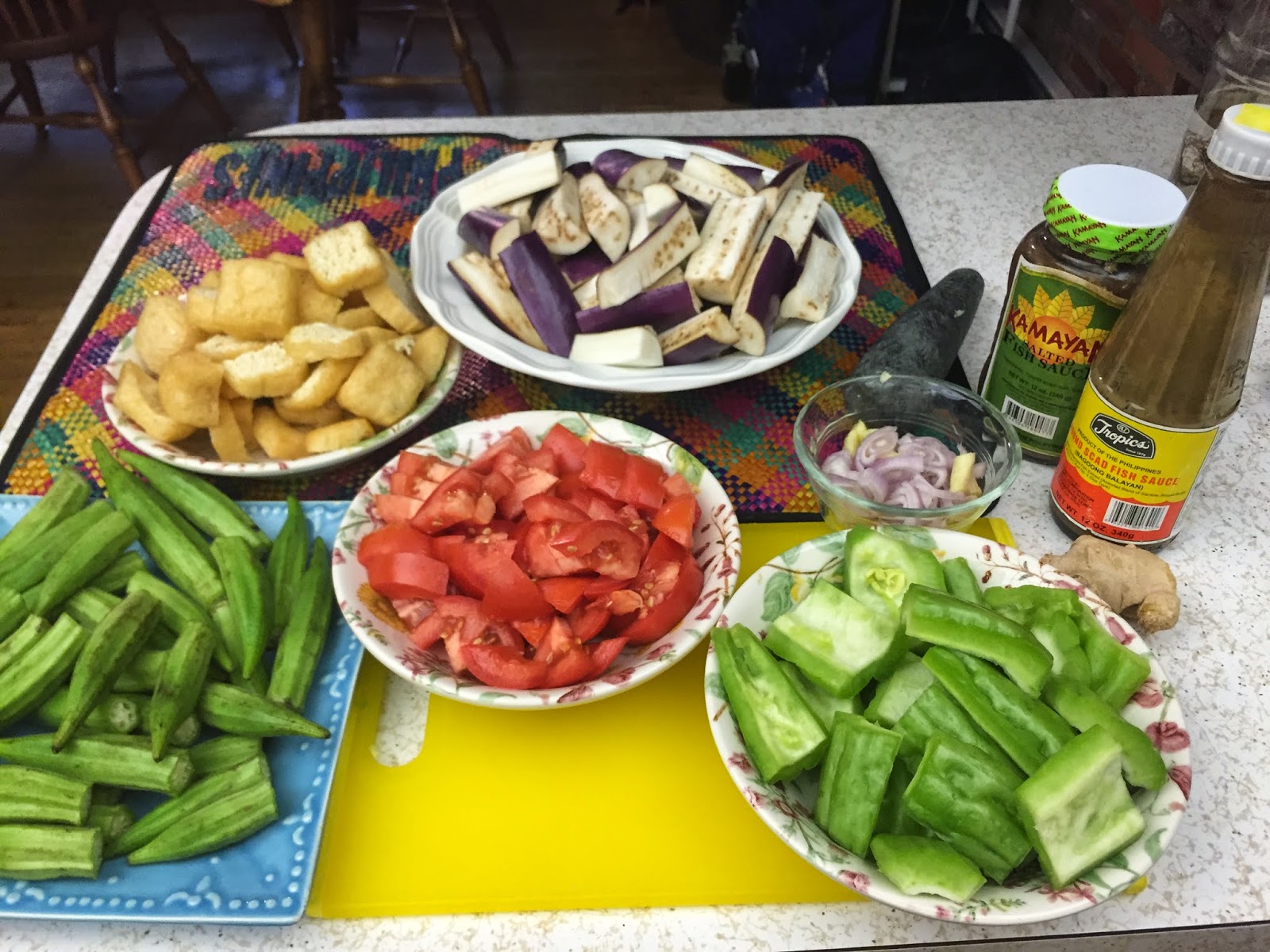
This is how vegetables should be cut for pinakbet or tokwakbet:


And remember that vegetables must be layered in the correct order so by the time the dish is cooked no vegetable becomes too mushy. Eggplant mushes up very fast so put it in last. The tomatoes should be added with the ginger to help make the broth. Bittermelon (paria/ampalaya) takes the longest to cook. Don't forget to remove the pulpy seeds of the bittermelon.

Remember that once the bittermelon is added to the dish. Do not stir the ingredients. That will cause the tokwakbet to become bitter. Shake it don't stir it!

Bittermelon may take a while to get used to but it is a very healthy vegetable and has been noted to help relieve arthritis and diabetes.

Anchovy paste must be strained before use so it does not itch the throat. We will show you how to do this in the video. This is used instead of salt. There is no need to add salt once the anchovy paste and water are added. Adding too much salt is bad for blood pressure.

A major ingredient of pinakbet that is not present in our tokwakbet is long Asian string beans called "sitaw" in Tagalog or "utong" in Ilocano. We propose that if you want to add utong to the tokwakbet, it should be called by another name, "tokwatbet" to help differentiate the dishes.

These are the ingredients you will need to make this dish - note the hiding ginger by the tomatoes and the small Philippine onion (lasona). These small onions are much more sharp and flavorful than the large white ones ordinarily used in Western cooking. It is fine to leave out the onions but NOT the ginger and anchovy paste. You will see in the video that we stir fried the onions, that is because without pork there is no fat for flavor so we used the oil as a healthier substitute. With genuine pinakbet, no stir frying is involved.

Note that the tofu that we use is spongy. This will better absorb the flavor of the broth.


Ready to try cooking this dish? Don't eat the flower. We just put that there for decoration. But you can add katuday if you like (below). We'll leave that for another episode.


Feel free to write the Filipino language academy demanding that "tokwakbet" be added as a bona fide word to the Philippine National Language.

Come see us next week at ChefRafi.com for more!

Sunday, August 10, 2014

Trondro Malagasy - Coconut Fish from Madagascar

And now for some Malagasy (Malgache)!

Ingredients (Ny zavatra ilaina)
Faly mifankahita aminao eto amin'ny fandaharana ity indray!!
Hahandro sakafo Malagasy aho izay fomba fahandro Sakalava -- trondro amin'ny voanio sy tamotamo. Ny Sakalava dia anaran'ny loko lehibe any amin'ny faritra andrefanan'i Madagasikara.


If you would like an aromatic smell in your house today, cook this dish. The fresh turmeric (tamotamo), ginger (sakamalao), onions (tongolobe), garlic (tongolo gasy), and coconut milk (ranom-boanio) blend to create the alluring fragrance. This particular dish originates in the Sakalava region of the beautiful island of Madagascar (Western Coast). See the map to the left we edited from a wikipedia map we saw from Lemur Baby.

And although the dish is Sakalava, we used the Merina language of the Central Highlands for this video, what is normally referred to as "Standard Malagasy" (lavender on map). If you are Sakalava, and would like to provide a Sakalava rendition for people to compare, please write us at chefrafi.com.
Fresh Turmeric
The secret to this dish is the use of fresh turmeric (tamotamo). Just be careful because turmeric stains things yellow. Don't wear white when cooking with this tuber!
You'll learn in the video how to differentiate turmeric from ginger (sakamalao). When the coconut cream becomes too thick, we can thin it with rice water (starchy water from the first rinsing) or just regular water.


So here are the ingredients for your shopping list:

1 kg fresh fish (trondro), 2 tomatoes (voatabia), 1 green pepper (sakaibe), parsley or cilantro to garnish (persila), 250mg coconut milk (ranom-boanio), 1 onion (tongolobe), 5 slices of ginger (sakamalao), 2 garlic cloves (tongolo gasy), turmeric (vovoka tamotamo), salt (sira), pepper (dipoavatra), lemon juice (ranom-boasary makirana kely), and cooking oil (menaka).

    This video will show you how to mix the ingredients:

--------------------------------------------------------------------------

Hanomboka ny fandraohana isika!

1. Sasao madio tsara amin’ny rano mangatsiaka ny trondro.
2. Rarao ranom-boasary makirana kely, sy sira ary dipoavatra ny trondro, saromy ary avelao hilona adin’ny roa ary apetraka ao anatin’ny vata fampangatsiahina.
3. Tetehina madinika ny tongolo gasy sy ny tongolobe.
4. Didio ny voatabia
5. Kikiso ny sakamalao
6. Arotsahy ao anaty vilany lehibe misy menaka mafana ny tongolo be ary ny tongolo gasy voatetika.
7. Aratsay ny sakamalao.
8. Ampio vovoka tamotamo, arotsay ny voatabia ary aleo hitanika mandritra ny minitra vitsi-vitsy. Manampy amin’ny fiadiana ny virosy sy ny mikraoba ny tamotamo!
9. Ampio ranom-boaniho sy rano eran’ny vera.
10. Haroina amin’ny sotrobe hazo.
11. Apetraka amin’ny izay ny trondro ary arotsaka ireo sakaibe voatetika.
12. Aleo hitanika manditra ny dimy minitra mandarapa marihitra ny ranom-boanio.
13. Rehefa masaka ny trondro dia asio sira sy dipoavatra, ary rarao persila voatetika sy ranom-boasary makirana kely raha tianao.

Mazotoa homana e! Tena matsiro ka!

Eat with warm rice - Hano miaraka amin'ny vary mafana.

Saturday, August 9, 2014

Sinigang na Baboy - Philippine Tamarind Soup - Kamyás

Sinigáng, a sour soup made with fish, shrimps or pork, is an excellent contender for the national dish of the Philippines. The flavors scream for the homeland and bring back nostalgic memories. Most Filipino cooks use MSG-laden premixed packages to make this delicious soup. Not Chef Rafi. He will show you how to create sinigang from scratch, using only fresh ingredients.

Tamarind or kamyás are common souring agents for this soup.
This dish is normally soured using tamarind fruit (sampalok), which can be substituted by unripe guavas (bayabas), kamyas (pias) or kalamansi. In the video, you'll see Chef Rafi prepare the taro and tamarind for this unique Filipino soup. His unique innovation to this classic recipe is that he uses red rice from Madagascar instead of white rice from the Philippines for the starchy rice broth. The subtle difference in flavor is a definite improvement.

Philippine Souring Agents:
Kamyas (Ilocano piás) is probably the most exotic ingredient here. The scientific name is Averrhoa bilimbi with the common English name of tree sorrel. If you're in an Indian market, ask for bilimbi. Chef Rafi used tamarind in the video instead of kamyás to sour the sinigáng. In the Southern Visayan Islands of the Philippines, they use yet another souring agent for sour stews - batwan. Chef Rafi will cook with this in a future video with his Hiligaynon Ilonggo friends.

Tagalog kamyás; Ilocano piás
Taro (Tagalog gábi; Ilocano ába) is used to thicken the broth (pampalapot). Do not overcook it or it will disintegrate and you won't be able to taste the delicious soup soaked into this flavorful root crop.

Here's your shopping list for this dish: garlic, onions, pork (or fish or shrimp), tamarind, tomato, fish sauce, okra, Chinese cabbage (bok choy/petsay), eggplant (optional), string beans (Tagalog sítaw, Ilocano utóng), and non-spicy chili pepper.

And here's your Filipino phrase for the day:
masaráp na sabáw (delicious broth in Tagalog)
naímas a digó (delicious broth in Ilocano)


The fancy bok choy chef Rafi used here gives this sinigáng a unique appearance.
Watch the video to cook sinigáng with Chef Rafi.
 
Chef Rafi thanks his Uncle Carlos for the beautiful photography of the Philippine flora.